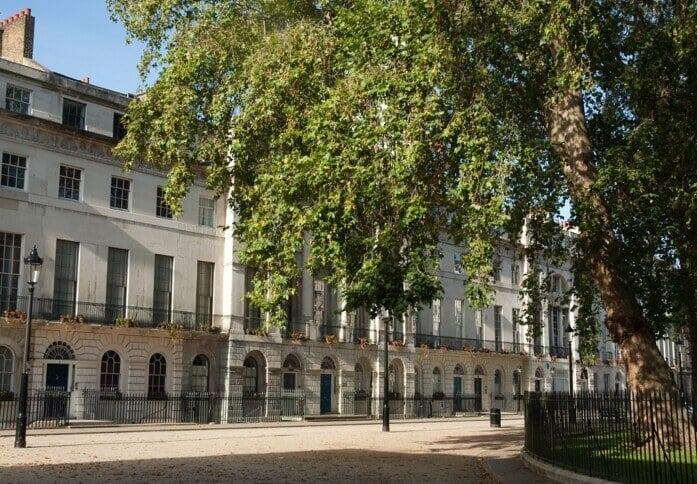
Fitzrovia lies north of Oxford Street, between the wider settings of Marylebone, Bloomsbury and Soho. Offices share its streets with homes, restaurants, galleries and institutional uses, creating a neighbourhood with a strong everyday identity. The contrast between active commercial roads and smaller adjoining streets is central to its character.
For businesses, Fitzrovia offers a West End position without requiring every working day to centre on the busiest shopping and entertainment routes. This guide considers its built form, professional atmosphere and relationship with surrounding districts, while recognising meaningful differences between individual streets.
Fitzrovia’s identity within Central London
Fitzrovia is a mixed neighbourhood rather than a single-purpose office quarter. Charlotte Street, Great Titchfield Street and the roads around them each contribute different combinations of hospitality, commerce and residential activity. The district’s identity comes from those overlapping uses.
Its central position also makes it a place people move through between other destinations. The main routes can feel animated, while smaller streets provide a more contained setting. This variety allows offices to relate differently to public activity without losing access to the wider West End.
Business culture and professional atmosphere
Creative, media and design-related associations form part of Fitzrovia’s professional identity. They sit alongside consultancies and other office occupiers using the area for its position, building choice and amenities. A team does not need to belong to one sector to find the setting useful.
The neighbourhood can support a working pattern that moves between office meetings and nearby hospitality. Colleagues may use the area beyond the working day as well, giving the workplace a relationship with a functioning neighbourhood rather than a district that empties immediately after office hours.
Architectural character and building form
Fitzrovia combines period terraces, former commercial premises, twentieth-century offices and more recent development. Individual frontages and changes in building height create a varied streetscape. The scale differs from the large tower clusters associated with parts of the City.
Office interiors vary as much as the façades. Adapted buildings may have distinctive rooms and circulation, while contemporary premises can offer more regular layouts. Teams should assess daylight, lift access, acoustics and the relationship between floors alongside any preference for architectural character.
Day-to-day working environment
Restaurant activity, deliveries and movement between stations contribute to the daily rhythm. Some streets remain lively into the evening, while others have a stronger residential or office character. The same area label can therefore describe workplaces with noticeably different surroundings.
The practical advantage is the range of amenities within walking reach. Food, errands and informal meetings can be accommodated locally. An office above or beside a busy venue should nevertheless be assessed in relation to its operating pattern and the building’s internal conditions.
Relationship with surrounding districts
Soho lies south of Oxford Street, with Marylebone to the west and Bloomsbury to the east. Tottenham Court Road forms an important connection along the eastern side of the wider neighbourhood. These relationships make Fitzrovia useful for businesses working across several central settings.
The exact position influences which relationship is strongest. A workplace near the southern edge may be closely tied to Soho and Oxford Street, while one further north can have a different station and amenity catchment. Regular journeys are a useful guide to choosing between them.
Public realm and green space
Fitzroy Square is a distinctive visual and architectural space in the northern part of the neighbourhood. Its central garden has managed access arrangements and should not be treated as an unrestricted public park. Other smaller spaces and nearby routes provide different options for outdoor breaks.
The wider district remains densely built, with street life more prominent than extensive parkland. Staff seeking a longer green-space walk may need to head beyond the immediate office streets. The usefulness of that option depends on location, route and available time.
Cultural and institutional presence
The Fitzrovia Chapel provides a distinctive connection with the former Middlesex Hospital site and the neighbourhood’s history. Its cultural programme adds a contemporary role to an unusual historic interior, illustrating the area’s layered identity.
Galleries and nearby institutions contribute further cultural activity without defining every street as a visitor destination. The broader relationship with Bloomsbury also brings academic and museum settings into the wider catchment. For office teams, culture forms part of the surrounding city rather than a separate business amenity.
Hospitality and meeting context
Fitzrovia has a substantial hospitality presence, particularly on streets known for restaurants and cafés. Teams can use local venues for brief catch-ups, client lunches and informal conversations. The range supports different meeting styles within a relatively compact area.
Popularity also brings busy periods and variable noise. A public venue may work well for relationship-building while providing limited privacy for detailed discussion. Businesses should consider dependable bookable space and their own meeting rooms alongside the surrounding offer.
Accessibility and movement
Goodge Street, Warren Street, Tottenham Court Road and Oxford Circus are useful reference points for different parts of Fitzrovia. The most convenient arrival depends on the office’s position and the traveller’s starting point. No single station represents the whole district equally well.
Walking links Fitzrovia with several neighbouring central areas. Busy crossings around Oxford Street and Tottenham Court Road can influence short routes, so the final approach deserves attention. Transport for London’s journey planner helps compare actual journeys.
Who Fitzrovia aligns with
Fitzrovia can suit teams that value a mixed central neighbourhood, varied building character and access to the wider West End. It may be particularly useful where working routines include regular local meetings and informal interaction outside the office.
Teams seeking a uniform corporate setting or extensive private outdoor space should assess individual options carefully. The district’s variety is a strength, but it means that the address alone cannot establish the right workplace atmosphere.
Fitzrovia’s continuing role
The relationship between offices, homes and hospitality gives Fitzrovia continuity as different buildings and businesses change. Its appeal rests on being part of central London’s daily life while retaining a recognisable neighbourhood scale.
For organisations considering a longer-term base, that mix provides useful context alongside transport and building quality. The strongest decision connects the team’s actual routines with a specific street and workplace.
Fitzrovia in context
Fitzrovia offers a layered working environment between several prominent central districts. Its character is found in the differences between streets and in the overlap of professional, residential and social life.
For a practical next step, you can view office space available in Fitzrovia and compare the individual settings.