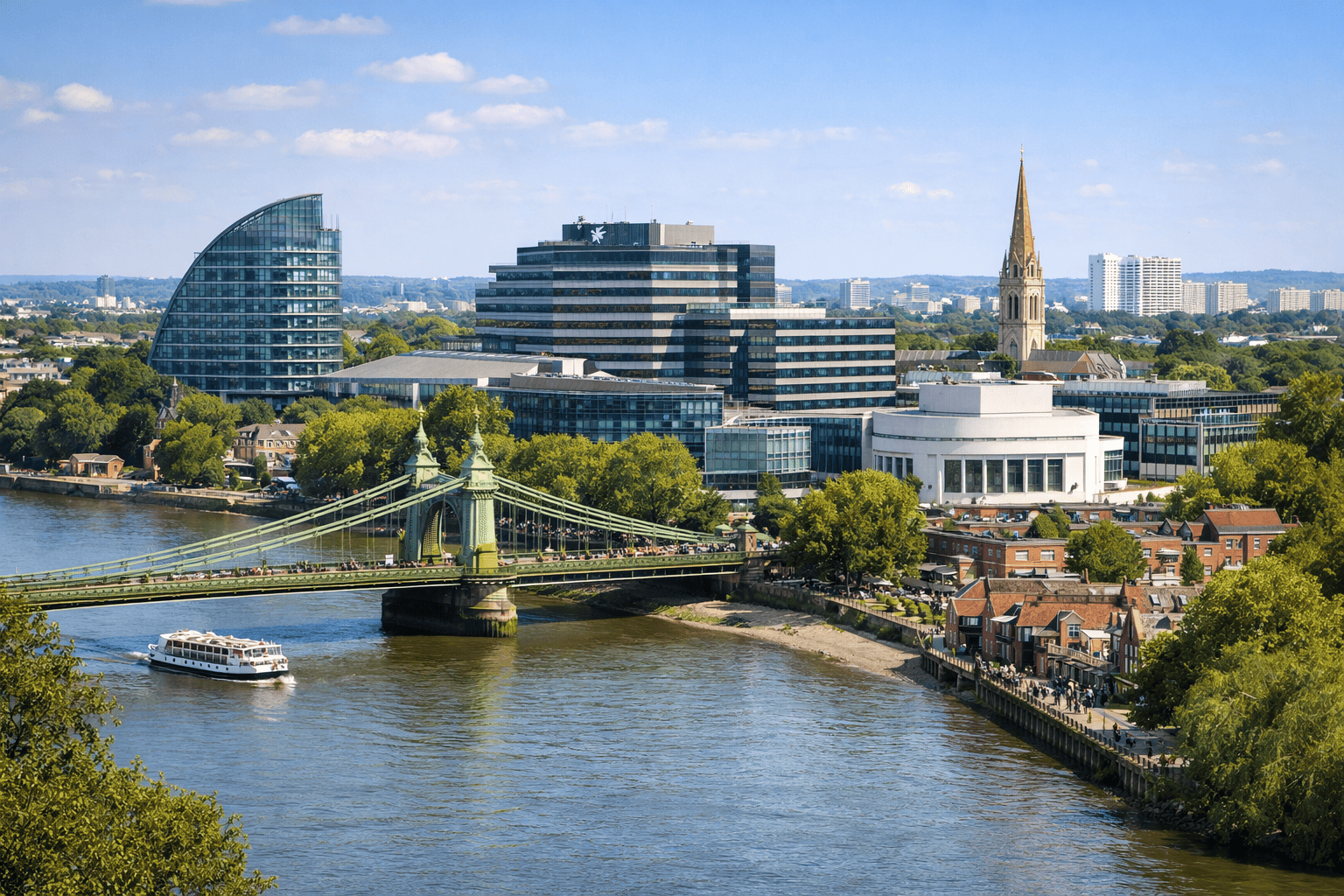
Hammersmith sits on the western edge of Central London, occupying a strategic position along the River Thames. Long established as a transport and commercial hub, Hammersmith combines strong connectivity with a more open and practical working environment than many inner West End districts. Its character is shaped less by heritage formality or creative density and more by functionality, scale and accessibility.
This area guide provides an editorial overview of Hammersmith as a business location, focusing on its character, environment and role within London rather than commercial detail.
Hammersmith’s identity within London
Hammersmith is defined by movement and connection. Historically a gateway between central London and the west, the area has developed around infrastructure, commerce and daily flow rather than exclusivity or cultural concentration. This has positioned Hammersmith as a pragmatic choice for organisations that value access, efficiency and visibility.
Within the wider London context, Hammersmith acts as a transition zone. It bridges Central London with West London residential districts and provides a base that feels connected without being congested. This dual role underpins much of its appeal.
Business culture and professional atmosphere
The professional culture in Hammersmith is structured, operational and outward-facing. Businesses here tend to prioritise clarity, accessibility and collaboration over discretion or informality. Meetings are planned, environments are professional, and working patterns align closely with standard business rhythms.
Compared with districts such as Soho or Mayfair, Hammersmith feels less performative and more functional. The atmosphere supports scale, coordination and routine, making it well suited to organisations with established teams and defined operational needs.
Architectural character and building form
Hammersmith’s built environment reflects its commercial evolution. The area features a mix of mid- to large-scale office buildings, commercial campuses and mixed-use developments alongside older residential streets. Buildings are generally broader in footprint and more uniform in form than those found in historic West End districts.
This architectural character creates a sense of openness. Streets are wider, buildings are set back, and internal layouts are often designed for efficiency rather than adaptation. The result is a built environment that prioritises practicality and capacity.
Day-to-day working environment
Working life in Hammersmith is steady and predictable. The area supports a clear separation between professional activity and leisure, with defined working hours and structured movement throughout the day. Footfall is consistent but controlled, and the pace feels balanced rather than intense.
Noise levels are moderate, and the environment accommodates larger teams without the density pressures experienced in more central locations. This stability contributes to a working atmosphere that is focused and manageable.
Relationship with surrounding districts
Hammersmith sits at the intersection of several West London areas, including Shepherd’s Bush, Fulham and Kensington. Each offers a different balance of residential, retail and commercial activity, but Hammersmith stands out for its role as a connector rather than a destination.
Its position allows organisations to operate across multiple parts of London while maintaining a single, accessible base. This regional connectivity reinforces Hammersmith’s identity as a hub rather than a niche district.
Public realm and green space
One of Hammersmith’s defining features is its access to open space. The River Thames runs along its southern edge, providing riverside paths and views that shape the area’s public realm. Nearby parks and open areas contribute to a sense of openness that contrasts with denser inner-city districts.
These spaces play a functional role in the working day, offering room for movement and pause without dominating the commercial environment. Green space in Hammersmith is integrated rather than ornamental.
Cultural and institutional presence
Hammersmith has a quieter cultural profile than central West End districts, but it hosts a number of established venues, institutions and broadcasters that contribute to its identity. Cultural activity here tends to be purpose-led rather than tourist-focused, supporting local engagement without altering the area’s professional tone.
This understated presence adds depth without distraction, reinforcing Hammersmith’s position as a working district first and foremost.
Hospitality and meeting context
Hospitality in Hammersmith is practical and accessible. Venues are generally larger, more relaxed and designed to accommodate groups rather than intimate, high-discretion meetings. Cafés, restaurants and riverside venues support informal interaction alongside structured business use.
Meeting culture reflects this balance. Discussions often take place in straightforward settings that prioritise comfort and convenience over formality or exclusivity.
Accessibility and movement
Accessibility is central to Hammersmith’s function. Movement through the area is efficient, with clear routes and a strong sense of orientation. While well connected to the wider transport network, Hammersmith also benefits from internal walkability that supports day-to-day movement without friction.
This ease of movement reinforces its appeal to organisations that rely on coordination across teams and locations.
Who Hammersmith aligns with
Hammersmith aligns with organisations that value scale, connectivity and operational clarity. It suits businesses with established structures, collaborative teams and a need for straightforward access across London.
It may be less suited to organisations seeking exclusivity, heritage character or creative immersion. Hammersmith’s strengths lie in practicality and balance rather than distinctiveness or tradition.
Hammersmith’s long-term role
Hammersmith has evolved in line with London’s broader commercial growth, adapting to changes in working patterns without losing its core function. Its role has remained consistent: to provide accessible, flexible space within reach of central markets.
As London continues to decentralise in certain sectors, Hammersmith’s position as a connected hub is likely to remain relevant.
Hammersmith in Context
Hammersmith is best understood as a place of connection and capacity. Its value lies in its ability to support scale, coordination and accessibility without the intensity of inner Central London. For organisations that prioritise function, movement and balance, Hammersmith occupies a clear and established position within London’s business landscape.
For practical next steps, you can view office space available in Hammersmith through City Hub Offices to see how the location translates into current opportunities.