Soho Area Guide
Soho occupies a unique position within Central London. Located between Oxford Street, Regent Street, Charing Cross Road and Shaftesbury Avenue, Soho has long been associated with creativity, independence and cultural exchange. Unlike districts shaped around formality or tradition, Soho has evolved through constant reinvention, absorbing waves of artistic, media and entrepreneurial activity while retaining a strong sense of identity.
This area guide provides an editorial overview of Soho as a business location, focusing on character, environment and context rather than commercial detail.
Soho’s identity within Central London
Soho is defined by intensity rather than scale. Its streets are compact, closely arranged and highly animated, creating a sense of proximity that shapes how people work and interact. The area has historically functioned as a meeting point between different communities, industries and ideas, which has given it a reputation for openness and experimentation.
Within the West End, Soho plays a connective role. It links major retail corridors with cultural and entertainment districts, while maintaining its own internal logic. This positioning has made Soho a long-standing base for businesses that value visibility, collaboration and creative energy over formality.
Business culture and professional atmosphere
The professional culture in Soho is informal, fast-moving and highly networked. Relationships tend to form through proximity and repeated interaction rather than structured introductions. Meetings are often spontaneous, short and conversational, reflecting the area’s pace.
Soho’s working atmosphere is shaped by overlap. Work, culture and social life intersect throughout the day, and boundaries between them are less rigid than in more traditional districts. This creates an environment where ideas circulate quickly, but also where focus depends on adaptability rather than isolation.
Architectural character and building form
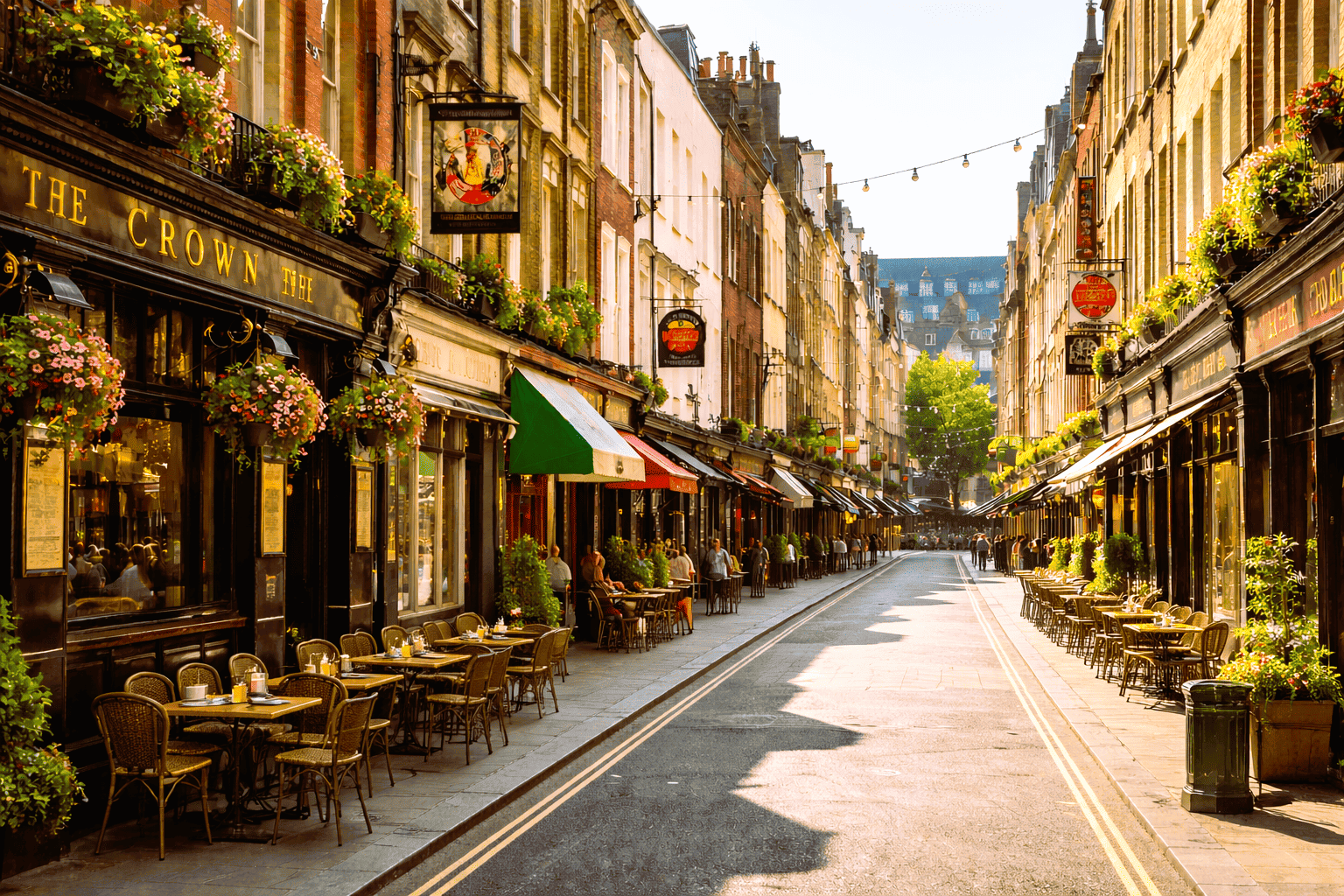
Soho’s built environment reflects its layered history. Streets are lined with a mix of Georgian townhouses, Victorian infill buildings and later twentieth-century additions. Unlike planned estates, Soho developed organically, resulting in irregular plots, narrow frontages and varied building heights.
Buildings tend to be low-rise, with multiple occupiers stacked vertically. Internal layouts often reflect incremental adaptation rather than comprehensive redevelopment, contributing to a sense of informality and flexibility. This architectural variety reinforces Soho’s identity as a place shaped by use rather than design.
Day-to-day working environment
Soho is consistently active. Footfall remains high throughout the working day, with a steady flow of professionals, visitors and residents sharing the same streets. Noise levels are higher than in neighbouring districts, but this activity is generally accepted as part of the area’s character rather than a disruption.
Working in Soho involves constant exposure to movement and interaction. For some, this energy is a catalyst for creativity and momentum. For others, it requires adjustment. The environment rewards those who thrive in visible, shared urban settings.
Relationship with surrounding districts
Soho sits between several contrasting Central London areas. To the north, Fitzrovia offers a more spacious and residential feel. To the south, Covent Garden blends retail and performance-led activity. To the west, Mayfair introduces a quieter, more traditional tone.
Soho’s role among these districts is distinct. It acts as a cultural and commercial hinge, absorbing influences while maintaining its own identity. Businesses based in Soho often engage with neighbouring areas daily, but use Soho as a base precisely because it offers immediacy and character rather than separation.
Public realm and green space
Soho has limited internal green space. Streets are dense and largely built-out, with few formal squares or gardens within its boundaries. This lack of open space is offset by proximity to nearby parks and pedestrian routes, which are typically accessed as extensions of the working day rather than as on-site amenities.
The public realm in Soho is defined more by street life than by landscape. Pavements, cafés and informal gathering points function as shared spaces, supporting interaction and visibility rather than retreat.
Cultural and institutional presence
Soho’s cultural significance is foundational rather than ornamental. The area has been closely linked to film, music, publishing and performance for decades, with many institutions operating quietly alongside commercial activity. Studios, production houses and independent venues coexist within the same blocks.
This cultural density contributes to Soho’s ongoing relevance. Rather than serving as a destination, culture is embedded into everyday activity, influencing the area’s rhythms and professional networks without dominating them.
Hospitality and meeting context
Hospitality in Soho is varied and informal. Venues are typically compact, lively and closely spaced, encouraging short meetings and regular interaction rather than extended formality. Many spaces are designed for flexibility, accommodating work-related conversation alongside social use.
The density of cafés, restaurants and bars supports a working pattern that relies on movement and accessibility. Meetings often take place off-site but within minutes of each other, reinforcing Soho’s reputation as a district where business happens in public view.
Accessibility and movement
Soho is highly walkable. Distances between key streets are short, and movement within the area is intuitive rather than linear. Its central position allows easy access to multiple parts of the West End on foot, reducing reliance on structured travel.
This walkability supports Soho’s fast-paced environment. Movement is constant but efficient, and the area functions as a central node rather than a destination at the edge of the city.
Who Soho aligns with
Soho aligns with organisations and professionals who value energy, visibility and creative exchange. It suits teams that operate collaboratively, respond quickly to change and benefit from being embedded in an active urban setting.
Conversely, it may not align with businesses that require quiet, formality or separation from public life. Soho’s openness and intensity are strengths for some and constraints for others.
Soho’s long-term role
Soho has demonstrated a capacity for renewal without losing its core identity. While individual buildings and uses change, the area’s underlying character remains intact. This resilience has allowed Soho to adapt to shifts in industry and working patterns while retaining its cultural relevance.
Within Central London, Soho continues to function as a creative anchor. Its role is less about prestige or scale and more about influence and connectivity.
Soho in Context
Soho is best understood as a place of convergence. Its value lies in density, interaction and continuity of activity. It does not offer distance from the city, but immersion within it. For organisations that benefit from proximity, visibility and cultural relevance, Soho occupies a distinct and enduring position within the West End.
For practical next steps, you can view office space available in Soho through City Hub Offices to see how the location translates into current opportunities.