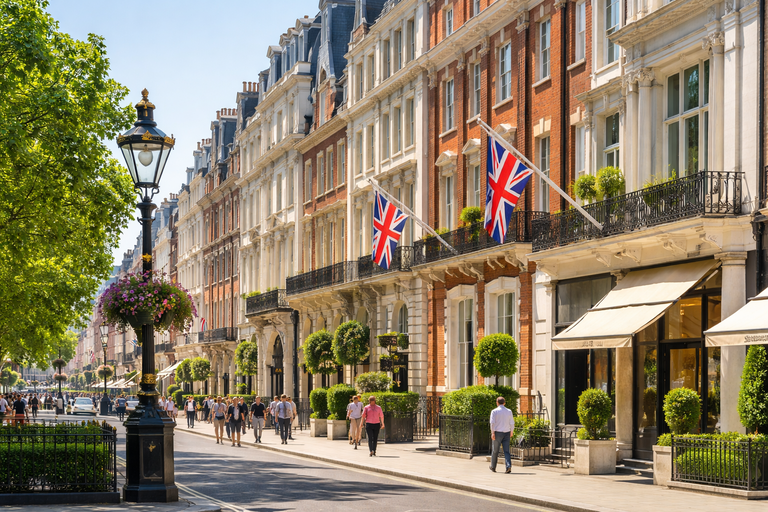
Mayfair occupies a distinctive position within Central London. Set between Green Park, Hyde Park and the wider West End, the area is associated with discretion, continuity and international relevance. Unlike districts shaped by rapid redevelopment or high-density commercial expansion, Mayfair has evolved gradually, preserving a measured pace and a recognisable identity. This has shaped not only its streets and buildings, but also the way the area functions day to day as a business location.
This guide provides a factual overview of Mayfair as a place to work, focusing on character, environment and context rather than commercial detail.
Mayfair’s identity within Central London
Mayfair is not defined by scale or visibility. Its reputation rests on restraint. The district has historically attracted institutions and individuals who value privacy, stability and long-term presence over footfall or public exposure. This is reflected in its streetscape, where many buildings sit behind understated façades, with little to signal their internal activity.
Within the wider West End, Mayfair functions as a counterbalance to busier neighbouring areas. It does not compete for attention with Soho’s creative energy or the retail intensity around Oxford Circus. Instead, it maintains a quieter, more controlled rhythm that has remained consistent over decades.
Business culture and professional atmosphere
The professional environment in Mayfair tends to be relationship-driven rather than transactional. Businesses based here often operate within close networks, with emphasis placed on trust, confidentiality and continuity. Meetings are typically planned and deliberate, rather than spontaneous or walk-in.
This culture influences how the area feels during working hours. Streets remain calm, with limited congestion and relatively low pedestrian density. Activity is present but contained, creating an environment that supports focused work and private discussion rather than constant movement.
Architectural character and building form
Much of Mayfair’s built environment dates from the eighteenth and nineteenth centuries, when the district developed as a residential quarter for established households. Many of these townhouses remain structurally intact, having been adapted internally over time while preserving their external form.
As a result, the area is characterised by low-rise buildings, consistent rooflines and formal street layouts. Large-scale towers are absent. Instead, buildings tend to be narrow in frontage and deep in plan, often arranged across multiple floors connected by central staircases.
The architectural continuity contributes to a cohesive appearance, reinforcing Mayfair’s sense of order and permanence.
Day-to-day working environment
Working life in Mayfair is shaped by predictability. The area rarely experiences sudden surges in activity or seasonal disruption. Retail presence is concentrated on specific streets rather than dispersed, and tourism tends to be focused around recognised institutions rather than spreading throughout the district.
This creates a working environment where routines remain consistent. Noise levels are generally low, streets are well maintained, and public spaces are not heavily overused. For professionals whose work benefits from calm and discretion, this stability is a defining feature.
Relationship with surrounding districts
Mayfair sits at the intersection of several prominent Central London areas, each with a distinct character. To the east, Soho offers a more informal, creative atmosphere. To the south, St James’s retains a similarly traditional tone, tied to long-standing institutions and private clubs. To the southwest, Belgravia presents a more residential and diplomatic setting.
Mayfair’s role within this network is specific. It provides a central yet insulated base, allowing straightforward access to neighbouring areas without absorbing their intensity. This positioning contributes to its long-standing appeal among organisations that operate across multiple parts of London but prefer a stable core location.
Public realm and green space
Despite its urban form, Mayfair benefits from proximity to some of London’s most significant green spaces. Hyde Park and Green Park lie within short walking distance, offering open landscapes that contrast with the area’s formal streets.
Within Mayfair itself, historic squares and gardens provide smaller-scale outdoor spaces. These are typically enclosed and carefully maintained, reinforcing the district’s preference for order and privacy over openness or spectacle.
Cultural and institutional presence
Mayfair’s cultural footprint is understated but significant. The Royal Academy of Arts contributes to the area’s artistic and intellectual heritage without changing the district’s overall tone. Galleries and private collections are present, often operating behind discreet entrances.
This cultural layer adds depth to the area without creating distraction. It reinforces the sense that commerce, culture and tradition coexist here without competing for attention.
Hospitality and meeting context
The hospitality landscape in Mayfair reflects its professional culture. Venues are typically refined, service-led and designed for conversation rather than volume. Many establishments prioritise privacy, offering controlled environments suitable for extended discussions.
Unlike districts driven by trend-led openings, Mayfair’s hospitality scene evolves slowly. Long-standing venues coexist with carefully positioned additions, maintaining continuity rather than disruption.
Accessibility and movement
Movement within Mayfair is defined by walkability. Distances between key points are short, and the street layout supports direct routes rather than complex navigation. The wider West End is readily reachable on foot, while the internal experience of Mayfair remains calm.
This balance between connectivity and containment allows the area to function efficiently without feeling transient. It is a place people arrive at intentionally, rather than pass through.
Who Mayfair aligns with
Mayfair tends to align with organisations and professionals who value discretion, continuity and environment over scale or visibility. It suits those who prefer a controlled setting, where surroundings reinforce credibility rather than novelty.
Equally, it may not align with organisations that depend on high footfall, rapid turnover, or constant informal interaction. Mayfair’s strengths lie in stability and reputation rather than pace and density.
Mayfair’s long-term role
One of Mayfair’s defining characteristics is its resistance to rapid change. Conservation priorities and planning constraints contribute to a slow evolution. This has preserved the district’s identity while allowing gradual adaptation to modern expectations.
As Central London continues to shift, Mayfair’s role remains consistent. It functions as an anchor, offering continuity amid broader changes in working patterns and urban development.
Mayfair in Context
Mayfair is best understood not as a high-energy district, but as a composed and enduring one. Its value lies in what it does not do as much as what it does. It avoids excess, resists volatility and maintains a professional environment shaped by history and restraint.
For those assessing Central London locations from a strategic perspective, Mayfair represents a distinct option: measured, established and quietly influential.
For a practical next step, you can view office space available in Mayfair and compare the location against other Central London options.